
May 15, 2026
The education of a general
Barry McCaffrey ’60, a retired four-star Army general, on Andover and what it takes to lead through a crisisby Hector Membreño-Canales
ON THE MORNING OF SATURDAY, FEBRUARY 28, 2026, the United States and Israel launched a coordinated military strike on Iran. By the time most Americans woke up to the news, scrolling through notifications, and toggling between feeds, smoke was already rising over Tehran. The operation, which President Trump publicly called “major combat operations,” had been launched without formal congressional authorization for the use of military force. It was, as critics have called it, the largest unilateral executive military action in a generation.
Barry McCaffrey had seen this kind of morning before. Not this morning exactly, but a particular quality about it was familiar. A reality that settles in when something that has long been theoretically possible has finally, irrevocably, happened.
McCaffrey is one of the most accomplished soldiers in American history. His career spans three decades and four combat tours, including command of the 24th Infantry Division during the Gulf War. He received three Purple Hearts, two Distinguished Service Crosses, and two Silver Stars. He served as a cabinet-level drug policy director under President Clinton and was a senior advisor to the chairman of the Joint Chiefs of Staff, Colin Powell. He traveled with President George H.W. Bush ’42 to some of the most sensitive diplomatic negotiations of the post-Cold War era. For the last decade and a half, he has been one of the most sought-after national security voices in American media, appearing regularly on network news and in major newspapers during the country’s most consequential moments.
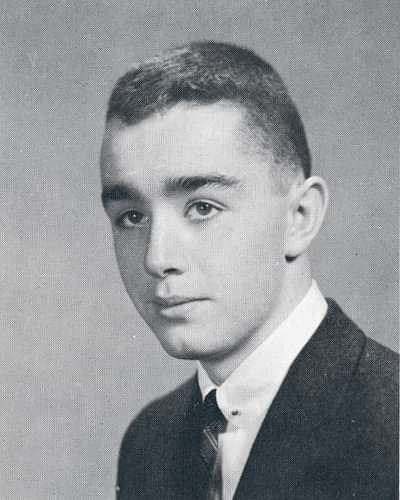 Barry McCaffrey from the Pot Pourri yearbook, Class of 1960
He is also, by his own jaunty admission, someone who arrived at Andover in the fall of 1959 convinced he was one of the smartest boys in the world. He was not, as it turned out. McCaffrey was smart and sharp enough to have been elected class
president at the American High School in Paris, where his father, a Boston-raised Army officer, had been stationed. He lettered in soccer and was president of the Honor Society. He had the confidence of a boy who has always, without much effort, been the most capable person in the room.
Andover changed the size of the room. I showed up and “thought I was ready,” McCaffrey says, laughing at himself across the span of 65 years. And then he got to math and started to panic. He had zero comprehension of what was being taught. Andover, in its characteristically resource-intensive way, addressed this by arranging for him to take math privately, at a faculty member’s home, in what he describes as “a class of one.”
He can still picture the man’s face as well as the faces of his English instructor and the football coach, who was the former Chief of Staff of the Yankee Division National Guard. That instructor, he recalls, had his students’ memorizing Shakespeare and passages from Ulysses. "I don't think you can ever really appreciate Shakespeare unless you've got a guide.” McCaffrey says, “he was it.”
What Andover gave him, before it gave him anything else, was a recalibration. The experience of discovering, at age 17, that he was not exceptional, that he was good—maybe very good—but that he was surrounded by people who were also very good, had a huge impact on him. For many students at Andover, this realization can either be devastating or clarifying. For McCaffrey, it was clarifying. He calls it “a huge dose of humility.” “It turned out,” he says, “I wasn’t one of the smartest boys in the world.” He pauses. “Bunches of others were.”
What Andover also gave him was a template for what institutions can do at their best. The math instructor’s patience. The English instructor’s rigor. He recalls a memorable moment when a faculty member pulled him aside after he was late to his work duty at Commons (he describes himself as a scholarship student, punching a clock) and told him, with no unnecessary drama, that he needed to be a grown-up now. Without any grand gestures, the adults at Andover paid close attention to young people and responded accordingly.
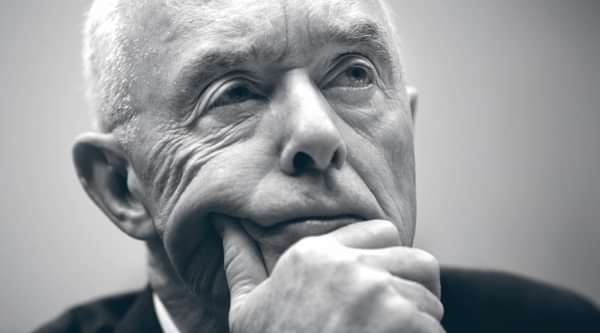 During a military career spanning more than three decades, Army Gen. Barry McCaffrey ’60 served in combat in Vietnam and commanded troops in the Gulf War. | Photo by Getty Images
McCaffrey carried that template into the military. He would later describe the best Army sergeants in the same terms: as teachers, not enforcers. People who set the example and who noticed. But the relationship between Andover and the military was not, for many years, a comfortable one.
McCaffrey graduated in 1960, went to West Point, and entered a career that, by the late 1960s, would put him on the wrong side of a cultural fault line that ran directly through institutions like Andover.
The faculty, the head of school, the student body, protests, activism, the moral weight of Vietnam, all pressed down on the moment. McCaffrey, on three combat tours as a lieutenant and captain, earned his first Distinguished Service Cross. The school and he, for a time, almost parted ways entirely.
“There was a tremendous separation,” he says. It was Barbara Landis Chase, Phillips Academy's first woman head of school (1994–2012), whose name he
invokes with evident warmth, who began the repair. Chase made a deliberate choice to reintegrate public service into Andover and to restore the armed forces to the list of things a young person of conscience might legitimately do with their life. Non sibi could mean wearing a uniform. It could mean choosing a form of sacrifice that made people uncomfortable.
McCaffrey went back to Andover as a Veterans Day speaker years later and found himself seated, while waiting to take the stage, between two seniors who were volunteers in Community Engagement’s Adopt-a-Platoon program—where students hand write letters to servicemembers deployed overseas.
“I was thrilled,” he says, “to see Andover come back to nurturing public service that included the Army, Navy, Air Force, and Marine Corps.”
To understand what McCaffrey brings to the analysis of a morning like February 28, 2026—the Iran strikes, the constitutional questions, the absence of congressional approval—helps us to understand what the inside of the national security apparatus actually looks like from the senior levels.
He spent years there. Every Saturday morning, he was in the White House National Security Council working through the week’s most pressing crises. The process was slow, deliberately so: legal input from the Department of Justice, the White House counsel, the Department of Defense, and the Joint Chiefs. The State Department’s small, brilliant, multilingual staff. The Gang of Eight on Capitol Hill. The careful cultivation of the press. The interminable leaks, because everything leaked.
Everything except what the NSC staff and the JCS managed to hold together, he shares. All of it was designed, over decades of institutional accretion, to ensure that when the United States acted, it did so with the broadest possible base of legal and political legitimacy.
“In a crisis,” he says, “we could make a decision in 90 days.”
He says it not as a complaint but as a description of what deliberation actually costs and what it buys. The 90 days were not wasted. They were the price of getting everyone in the same room and making sure that when the United States did something, it meant something.
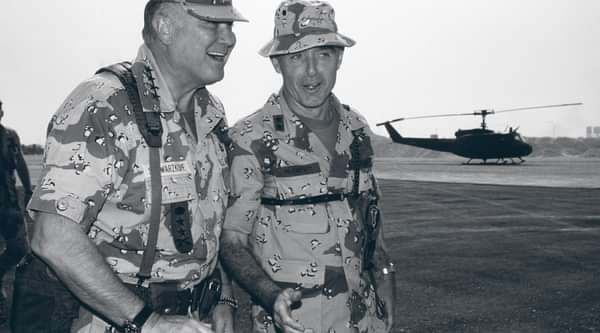 Barry McCaffrey (right) talking with Gen. Norman Schwarzkopf during a visit with Allied units that took part in Operation Desert Storm. | Photo by Getty Images
He has served under presidents of both parties. He describes George H.W. Bush ’42 as a man of integrity and caution who kept McCaffrey in the room during sensitive foreign policy meetings specifically because he wanted a military perspective present and trusted him to brief in eight minutes.
Bill Clinton, he adds, did his homework: he read the briefing books and remembered what was in them. Clinton once told a State Department official in the Oval Office, “I’ve already read the read-ahead, tell me what’s beyond it,” and meant it.
Clinton, McCaffrey says, was the kind of person who walked into a room of 250 donors, senators, foreign ministers, and ambassadors and went straight to the single Black mother standing at the edge of the room, or the uniformed police officer who happened to be there.
“He was just a really good person,” McCaffrey says. What he is describing, in both cases, is a specific kind of character that he learned to recognize at Andover and spent his career watching for. The person who does the work, who pays attention, who leads by example rather than by force of position. The person whose humility is not performance but practice.
When I spoke with McCaffrey in the weeks following the Iran strikes, he was, by his own account, uncomfortable. The conversation had oscillated from the constitutional implications of the operation over the state of democratic institutions, to what it means to govern without the deliberative infrastructure that he had spent his career inside. He is a man who says what he thinks, on television and in private, and he has said a great deal.
But Andover magazine, he felt, was not the right venue for all of it. He said so directly.
There is a version of this article that would use his name to relitigate arguments he makes elsewhere, on different stages, for different audiences. That is not what he believes the school’s publication is for. What it is for, perhaps, is this: a four-star general, Class of 1960, who arrived on campus believing he had already figured himself out, and found that the institution had other plans for him. Who learned, in a faculty member’s home, over a mathematics textbook, that being corrected is not the same thing as being diminished. Who carried and upheld the model of Andover’s best teachers—attentive, rigorous, demanding, yet kind.
Through four combat tours, two presidential administrations, 15 years on corporate boards, and a career in front of television cameras, he still reaches for these values when describing what good leadership looks like.
“When presented with good leadership,” he told me, “young people rise to the highest potential they have.”
Like the students he has watched at Andover over the years. The soldiers he has commanded. The faculty member who sat across from him in 1959, and waited while a boy who thought he was the smartest person in the world tried to understand math. It is, McCaffrey suggests, what the moment has always required.
“The question,” he offers, for all of us watching the smoke rise overseas and wondering what comes next, “is how to guide young people in a way that nurtures their highest potential in a complex world.”
Writer Hector Membreño-Canales is the Francis C. Robertson Chair of the Art Department on the Independence Teaching Foundation and a Civil Affairs officer in the U.S. Army Reserve.
Other Stories