

Science

Majors:
Biology - First Year
Chemistry-First Year
Introduction to Astronomy
Physics-First Year
The Dynamic Body
Minors:
Physics and Mechanical Engineering with Legos
Prep for Advanced Placement Chemistry
The History of Science
SAT II Physics Prep
All Grades
MAJOR
This course covers the main ideas of mechanics and provides a solid foundation of concepts, confidence in problem solving and exposure to laboratory techniques. Although this course does not cover a full year's worth of material, the techniques learned are an excellent preparation for all introductory physics topics.
Requirements: Texas Instruments, TI-84 graphing calculator or its equivalent.
Prerequisite: one year of algebra is required.
to the top
Grades 10-12
MAJOR
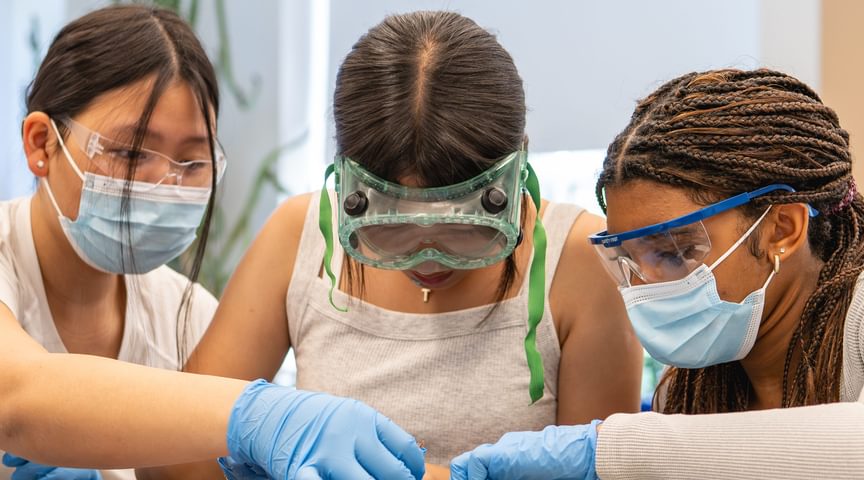
This course is geared toward highly motivated students who show an interest in science and who have demonstrated strong mathematical and conceptual abilities. As an introduction to chemistry, students in this intensive class learn essential chemical principles like stoichiometry, atomic and molecular structure, chemical bonding theories, and the properties of gases, liquids, solids and solutions. The very fundamental concepts of chemical equilibrium and acid-base chemistry are also presented and the students are introduced to the topic of electrochemistry. The course is balanced by a combination of lectures, problem-solving exercises and laboratory work.
Requirement: Texas Instruments TI-84 Graphing Calculator or its equivalent
Prerequisite: One year of Algebra.
to the top
All Grades
Extended Minor
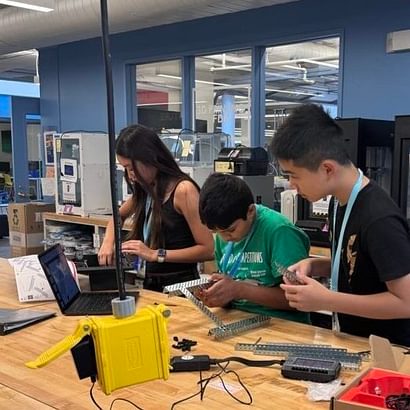
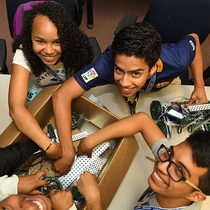
This laboratory course features a wide range of physics and mechanical engineering topics. Students explore the topics covered in discussion through daily hands-on experimentation with LEGOs and the powerful new LEGO microcomputer, the RCX. Throughout the term the students learn Labview, a visual computer programming language used for data acquisition that drives the RCX robots to execute the students' programs and carry out specified tasks. Daily experimentation culminates in a team-produced "systems engineering project", a team challenge that displays the students' newly acquired knowledge. Their final project makes use of the experimentation and data-logging capabilities of the RCX and its sensors, with which the students design, construct, and program a robot that carries out a scientific experiment and returns with data for further analysis.
Prerequisites: one year of either chemistry, physics and/or algebra.
to the top
Grades 11-12
MAJOR
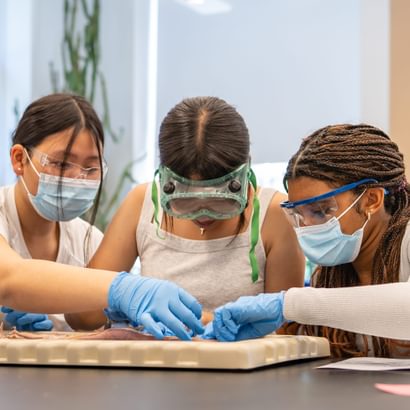
This major course focuses on the anatomical and physiological workings of the human body. Among the anatomy and physiology topics introduced are histology, kinesiology, cardiology and genetics. Students learn to identify anatomical structures as well as their functions in relation to daily bodily activities. Student work is assessed by written reports, examinations, lab practicals based on dissection and research topics. Students have the opportunity to leave this course with their own portfolio materials focused on topics introduced in the class setting.
to the top
All Grades
MAJOR
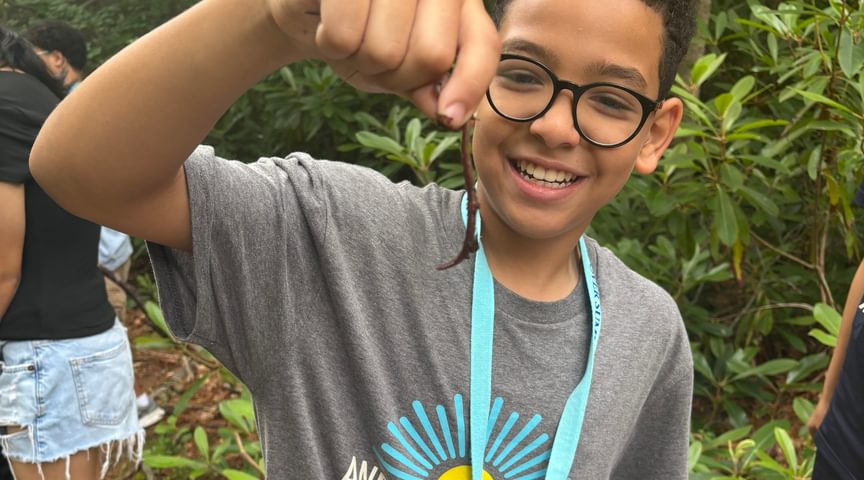
This is an intensive introductory lecture, laboratory, and field course designed to investigate and explore biological concepts and principles. Units covered include: ecology, plant biology, animal diversity, concepts of animal structure, and cellular biology. Scientific writing is also emphasized. The framework of the course is a student’s conceptual understanding of biology. However, an emphasis is placed on biology as a process, rather than an accumulation of facts.
to the top
All Grades
MAJOR
Modern astronomy is a quest for a greater understanding of the evolution and diversity of the Universe, as well as an application of critical thinking skills to broader questions in physics, chemistry, biology, and environmental science. This class examines both the current state of the science along with the future avenues of research and discovery. Topics include traditional areas of emphasis like the electromagnetic spectrum, light, telescopes, navigating the night sky, solar system formation, the planets, global climate change, comets and asteroids, the sun and the life cycle of stars. We will also apply a critical analysis to the broader questions that include the search for life in the universe and connections to life in niches on this planet. We will keep a close eye on current research and examine the history of science through the eyes of non-conventional thinkers like Einstein and Galileo. Lastly, we will examine some of the more exotic questions that are stretching the limits of modern science like black holes, ion propulsion, dark energy, and life in extreme environments. We will make use of the extraordinary imagery and resources available here at Phillips Academy, especially including the state of the art observatory perched atop the brand new Gelb science center, which opened in 2004. Throughout the term, students will engage the science critically and capture a snapshot of this emerging field of science.
to the top
The History of Science
Extended Minor
Grades 10 - 12
This course will help students develop a critical approach to science through the exploration of its history. We will examine the origins of modern biology, chemistry and physics – including the re-creation of historical experiments – in order to develop a sense of the value and limits of scientific knowledge. Students will explore key scientific revolutions and become familiar with the work and lives of famous scientists including Ptolemy, Galileo, Darwin, Newton and Einstein. The course will also consider the historical interrelation between science and religion and the fundamental, but deceptively difficult question, “what is science?”. Classes in the history of science are not available to most secondary school students, and thus this is an opportunity for any aspiring scientist or historian to learn to read carefully, to write analytically and to speak persuasively about the development of modern scientific understanding.
to the top
Prep for Advanced Placement Chemistry
Extended Minor
Grades 10 - 12
This course is intended for highly motivated students who are getting ready to take an AP Chemistry course and have demonstated strong mathematical and conceptual abilities. Students learn essential chemistry principles like stoichiometry, atomic and molecular structure, chemical bonding theories, and the properties of gases, liquids, solids, and solutions.The very fundamental concepts of chemical equilibrium and acid-base chemistry also are presented, and the students are introduced to the topic of electrochemistry. The course is balanced by a combination of lectures, problem-solving exercises, and laboratory work. The course uses a college-level textbook and covers topics at a depth equivalent to that of an introductory college chemistry course.
Requirement: Texas Instruments TI-84 graphing calculator or its equivalent.
Prerequisite: One year of Algebra.
to the top
SAT II Physics Prep
Extended Minor
Grades 11 - 12
This course is intended for students who have just completed a year of physics. Many high school physics courses do not have the time to cover all of the material included in the SAT II physics test. This course fills in the gaps and prepares students to take the SAT II in October.
to the top